Results were found under
videos, presentations, posters, papers .
There are no videos within this category so far.
There are no presentations within this category so far.
There are no posters within this category so far.
Astrophysics and Astrononmy
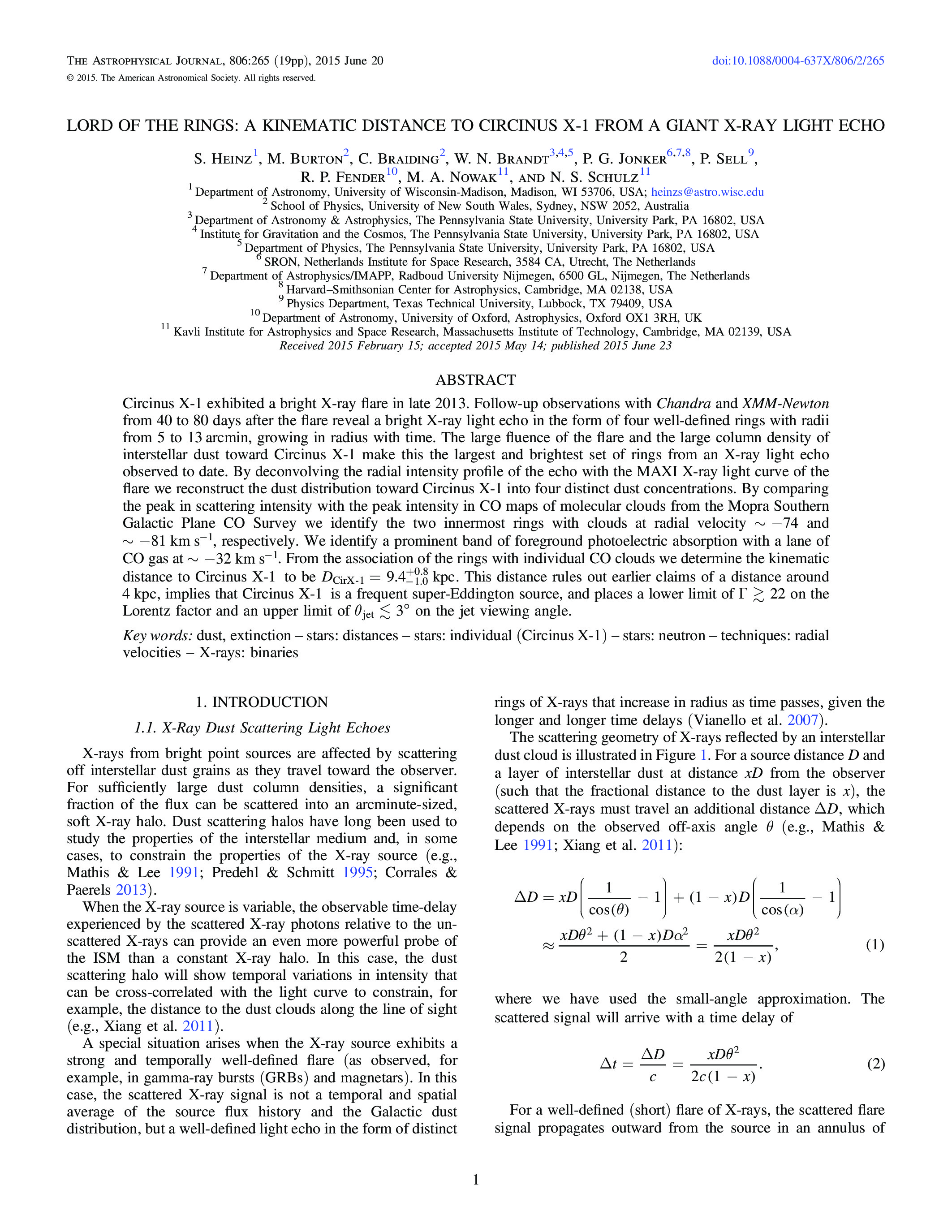
LORD OF THE RINGS: A KINEMATIC DISTANCE TO CIRCINUS X-1 FROM A GIANT X-RAY LIGHT ECHO
Natural Sciences (Astrophysics and Astrononmy)
Date of upload:
25.12.2015
Co-author:
S. Heinz , M. Burton, C. Braiding , W. N. Brandt , P. G. Jonker, P. Sell , R. P. Fender, M. A. Nowak, and N. S. Schulz
Abstract:
Circinus X-1 exhibited a bright X-ray flare in late 2013. Follow-up observations with Chandra and XMM-Newton from 40 to 80 days after the flare reveal a bright X-ray light echo in the form of four well-defined rings with radii from 5 to 13 arcmin, growing in radius with time. The large fluence of the flare and the large column density of interstellar dust toward Circinus X-1 make this the largest and brightest set of rings from an X-ray light echo observed to date. By deconvolving the radial intensity profile of the echo with the MAXI X-ray light curve of the flare we reconstruct the dust distribution toward Circinus X-1 into four distinct dust concentrations. By comparing the peak in scattering intensity with the peak intensity in CO maps of molecular clouds from the Mopra Southern Galactic Plane CO Survey we identify the two innermost rings with clouds at radial velocity ~ -74 and 81 km s ~ - -1 , respectively. We identify a prominent band of foreground photoelectric absorption with a lane of CO gas at 32 km s ~ - -1. From the association of the rings with individual CO clouds we determine the kinematic distance to Circinus X-1 to be DCirX 1 9.4 kpc 1.0 0.8 = - + ‐ . This distance rules out earlier claims of a distance around 4 kpc, implies that Circinus X-1 is a frequent super-Eddington source, and places a lower limit of G 22 on the Lorentz factor and an upper limit of q jet 3 on the jet viewing angle.
Modelling solar and stellar brightness variabilities
Natural Sciences (Astrophysics and Astrononmy)
Date of upload:
20.12.2015
Co-author:
K.~L.~Yeo; N.~A.~Krivova; S.~K.~Solanki
Abstract:
Total and spectral solar irradiance, TSI and SSI, have been measured from space since 1978. This is accompanied by the development of models aimed at replicating the observed variability by relating it to solar surface magnetism.
Despite significant progress, there remains persisting controversy over the secular change and the wavelength-dependence of the variation with impact on our understanding of the Sun's influence on the Earth's climate. We highlight the recent progress in TSI and SSI modelling with SATIRE. Brightness variations have also been observed for Sun-like stars. Their analysis can profit from knowledge of the solar case and provide additional constraints for solar modelling. We discuss the recent effort to extend SATIRE to Sun-like stars.
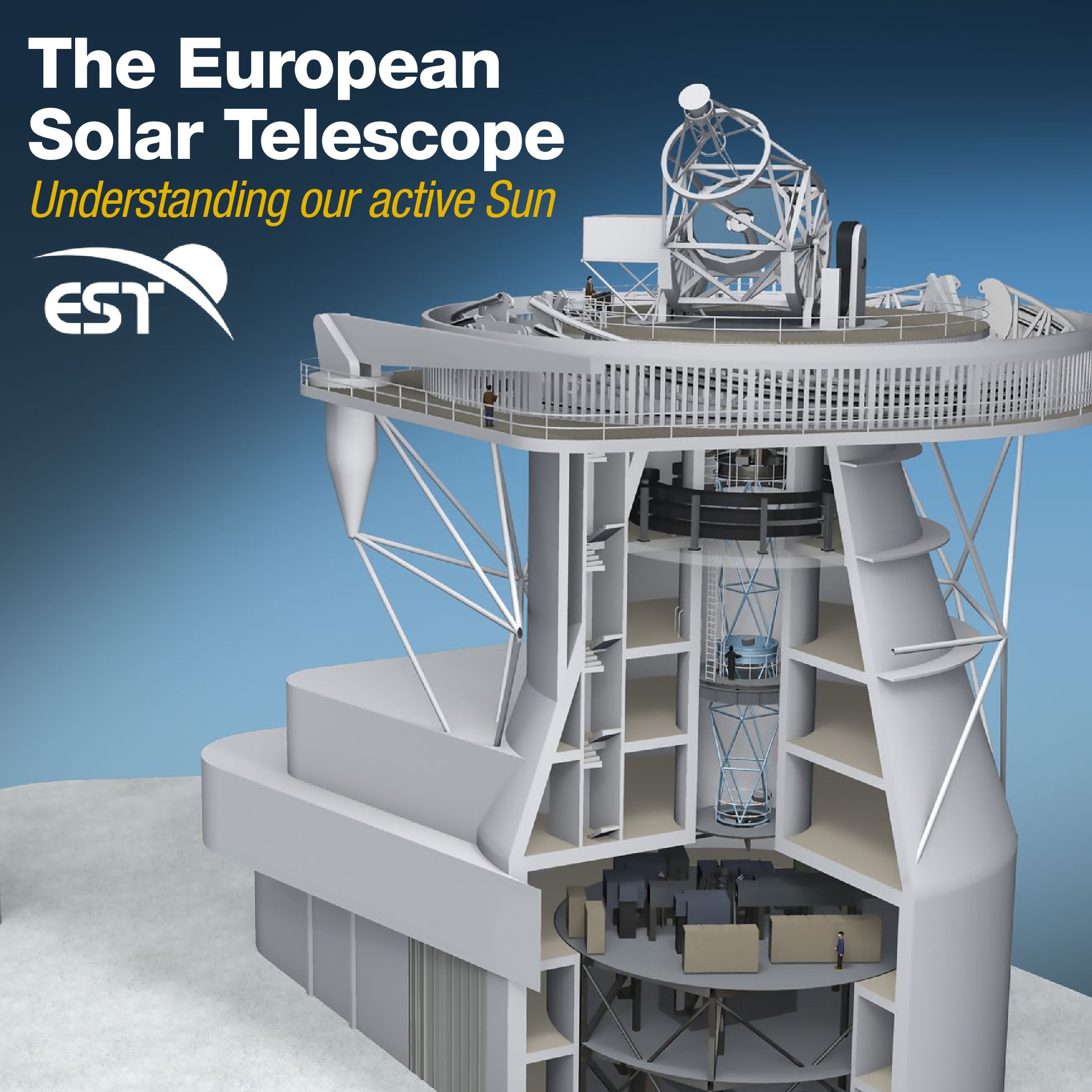
The European Solar Telescope - Understanding Our Sun
Natural Sciences (Astrophysics and Astrononmy)
SOLARNET - High Resolution Solar Physics Network
Date of upload:
03.07.2018
Abstract:
Here you can download the EST Brochure.
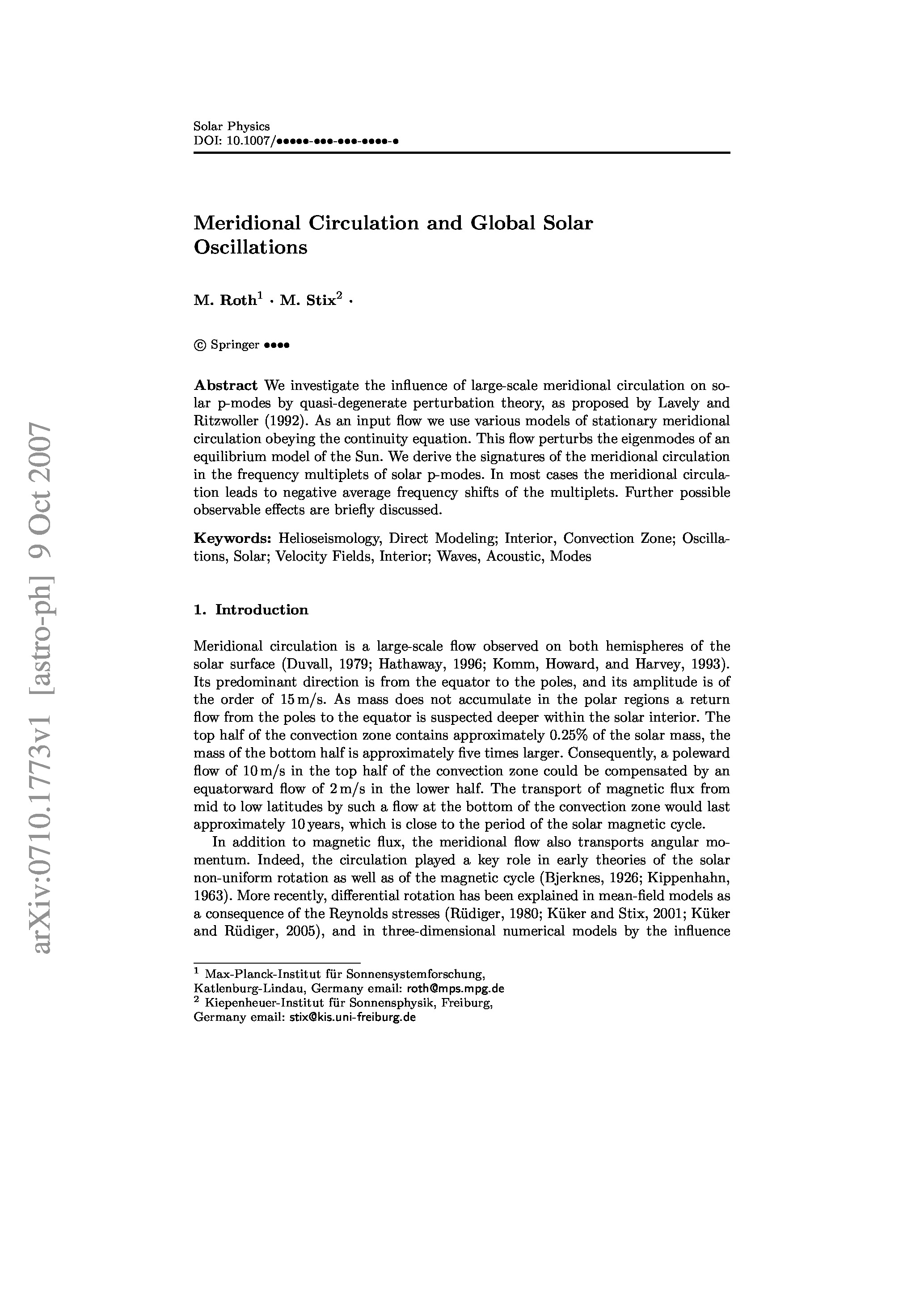
Meridional Circulation and Global Solar Oscillations
Natural Sciences (Astrophysics and Astrononmy)
Date of upload:
23.06.2015
Abstract:
We investigate the influence of large-scale meridional circulation on solar p-modes by quasi-degenerate perturbation theory, as proposed by Lavely and Ritzwoller (1992). As an input flow we use various models of stationary meridional circulation obeying the continuity equation. This flow perturbs the eigenmodes of an equilibrium model of the Sun. We derive the signatures of the meridional circulation in the frequency multiplets of solar p-modes. In most cases the meridional circulation leads to negative average frequency shifts of the multiplets. Further possible observable effects are briefly discussed.
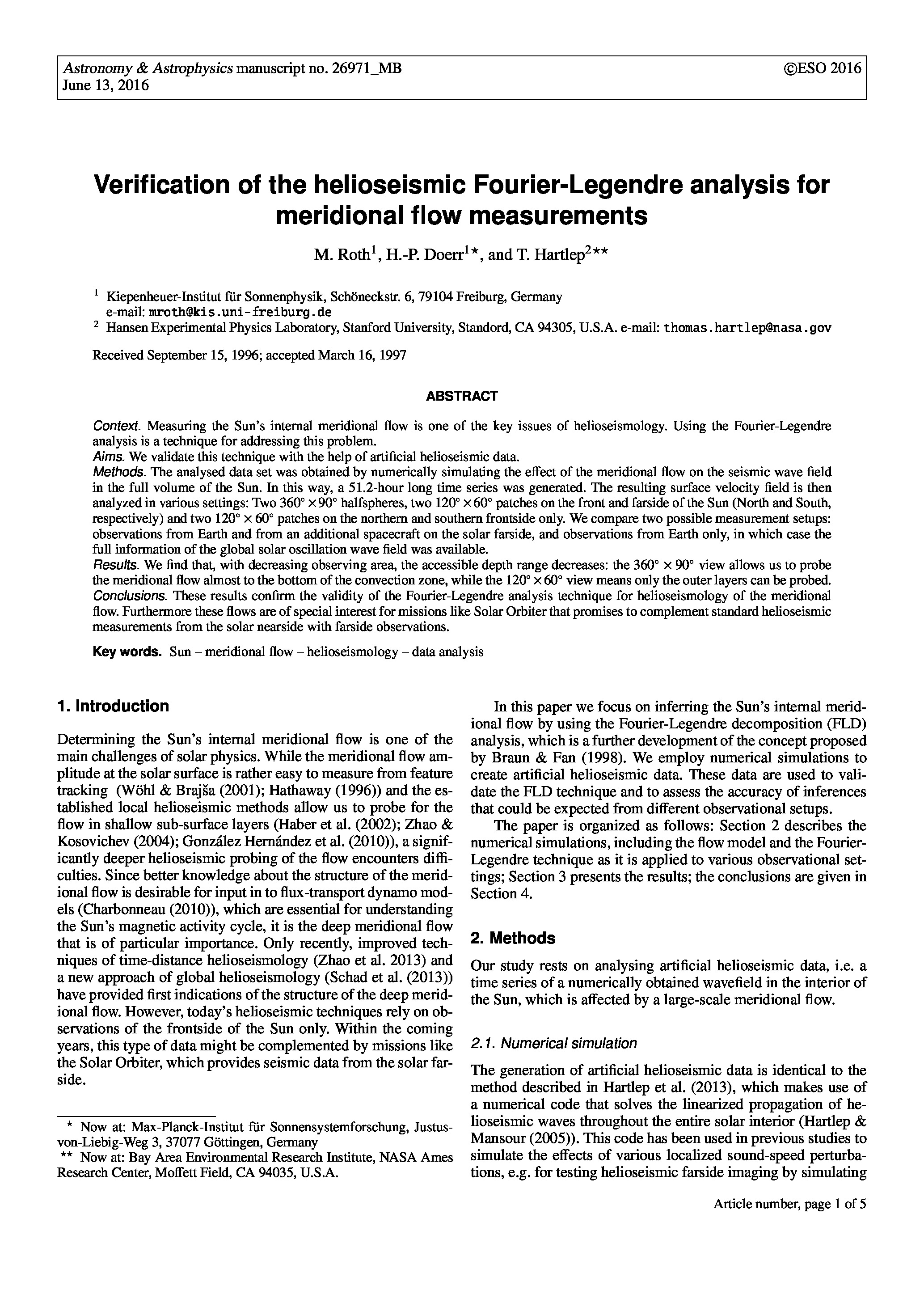
Verification of the helioseismic Fourier-Legendre analysis for meridional flow measurements
Natural Sciences (Astrophysics and Astrononmy)
Date of upload:
08.07.2016
Co-author:
H.-P. Doerr, T. Hartlep
Abstract:
{Measuring the Sun's internal meridional flow is one of the key issues of helioseismology.
Using the Fourier-Legendre analysis is a technique for addressing this problem.}
{We validate this technique with the help of artificial helioseismic data.}
{The analysed data set was obtained by numerically simulating the effect of the meridional flow on the seismic wave field in the full volume of the Sun. In this way, a 51.2-hour long time series was generated.
The resulting surface velocity field is then analyzed in various settings: Two $360^\circ \times 90^\circ$ halfspheres, two $120^\circ \times 60^\circ$ patches on the front and farside of the Sun (North and South, respectively) and two $120^\circ \times 60^\circ$ patches on the northern and southern frontside only.
We compare two possible measurement setups: observations from Earth and from an additional spacecraft on the solar farside, and observations from Earth only, in which case the full information of the global solar oscillation wave field was available.
}
{We find that, with decreasing observing area, the accessible depth range decreases: the $360^\circ \times 90^\circ$ view allows us to probe the meridional flow almost to the bottom of the convection zone, while the $120^\circ \times 60^\circ$ view means only the outer layers can be probed.}
{These results confirm the validity of the Fourier-Legendre analysis technique for helioseismology of the meridional flow. Furthermore these flows are of special interest for missions like Solar Orbiter that promises to complement standard helioseismic measurements from the solar nearside with farside observations.}
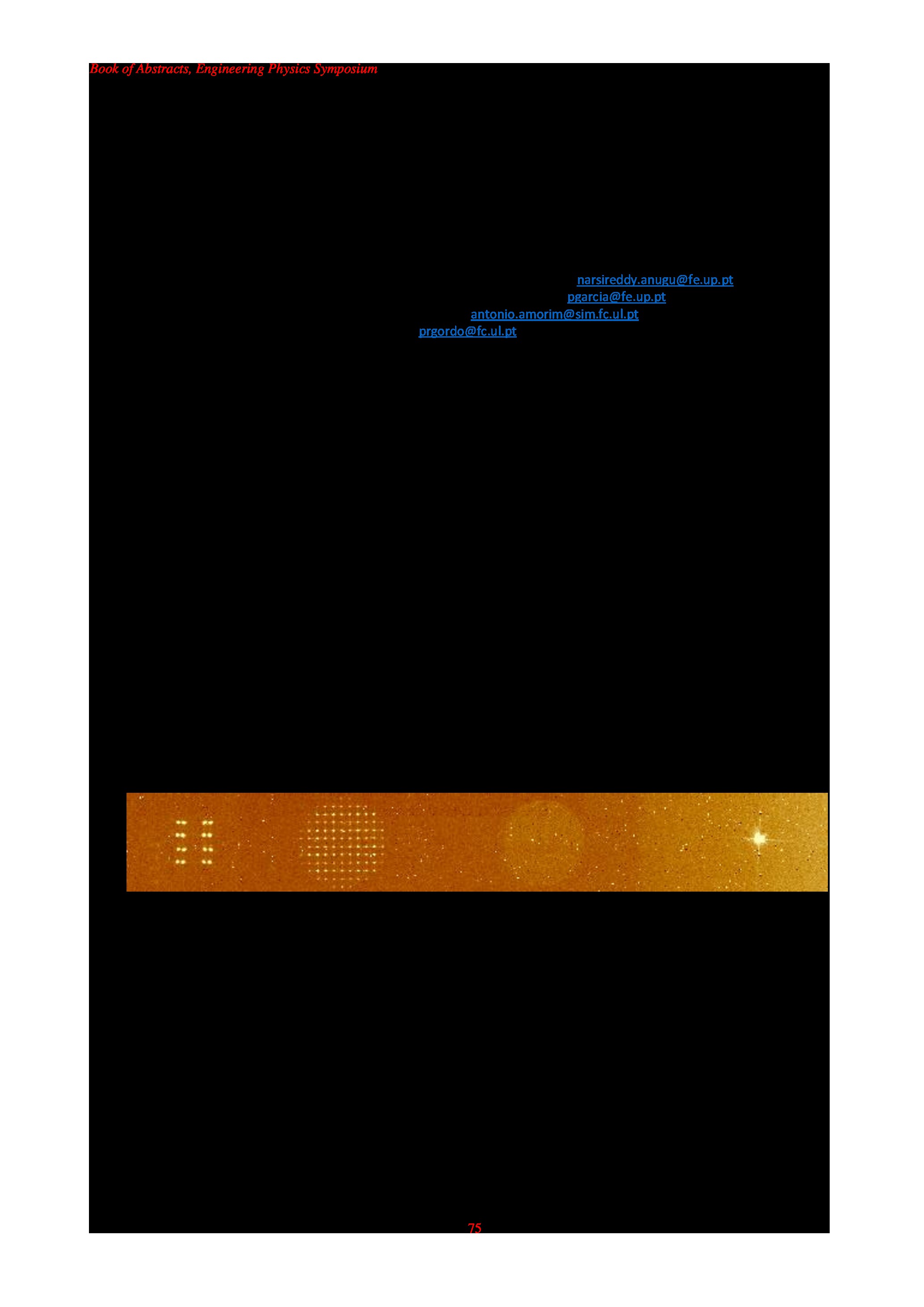
GRAVITY near infrared multiple beams analysing system: software and characterization results
Natural Sciences (Astrophysics and Astrononmy)
Date of upload:
20.10.2015
Co-author:
Paulo Garcia, Antonio Amorim, Paulo Gordo and GRAVITY consortium
Abstract:
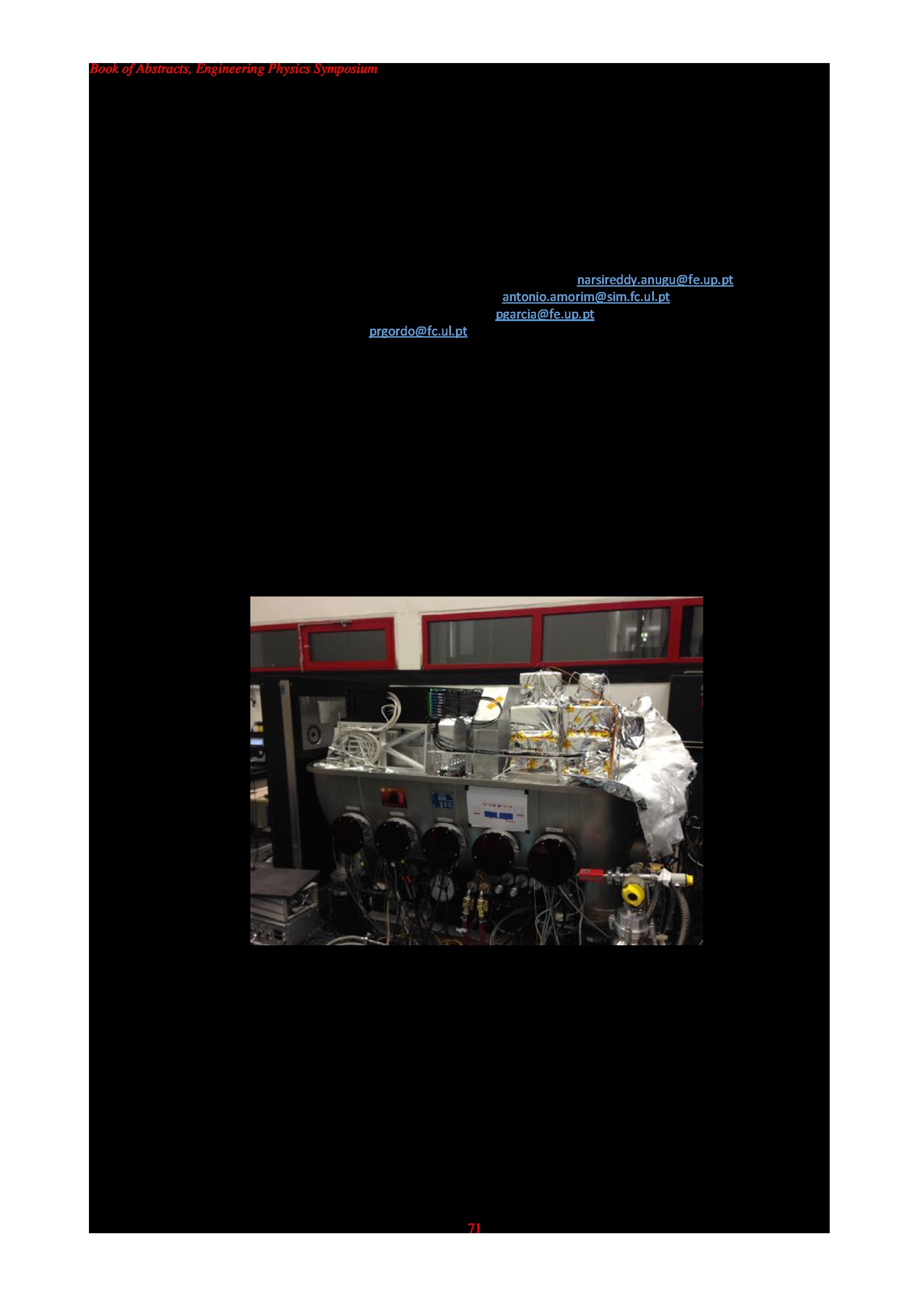
We report the status and the characterization results of the GRAVITY acquisition camera.
Experimental results for infrared aberration tracking using a correlation algorithm on two star extended field
Natural Sciences (Astrophysics and Astrononmy)
Date of upload:
20.10.2015
Co-author:
Paulo Garcia, Antonio Amorim, Paulo Gordo and GRAVITY consoritum
Abstract:
We report an experimental results of different correlation algorithms for an extended source wavefront sensor.
Measurement of the VLT pupil motions using a 2 × 2 lenslet evaluated aberrations
Natural Sciences (Astrophysics and Astrononmy)
Date of upload:
21.10.2015
Co-author:
Antonio Amorim, Paulo Garcia, Paulo Gordo and GRAVITY consortium
Abstract:
We present the telescope pupil tracking strategy for the GRAVITY interferometer.
The Importance of Long-term Synoptic Observations and Data Sets for Solar Physics and Helioseismology
Natural Sciences (Astrophysics and Astrononmy)
Date of upload:
15.03.2016
Co-author:
Yvonne Elsworth, Anne-Marie Broomhall, Sanjay Gosain, Stuart M. Jefferies, Frank Hill
Abstract:
A casual single glance at the Sun would not lead an observer to conclude that it varies. The discovery of the 11-year sunspot cycle was only made possible through systematic daily observations of the Sun over 150 years and even today historic sunspot drawings are used to study the behavior of past solar cycles. The origin of solar activity is still poorly understood as shown by the number of different models that give widely different predictions for the strength and timing of future cycles. Our understanding of the rapid transient phenomena related to solar activity, such as ares and coronal mass ejections (CMEs) is also insufficient and making reliable predictions of these events, which can adversely impact technology, remains elusive. There is thus still much to learn about the Sun and its activity that requires observations over many solar cycles. In particular, modern helioseismic observations of the solar interior currently
span only 1.5 cycles, which is far too short to adequately sample the characteristics of the plasma
ows that govern the dynamo mechanism underlying solar activity. In this paper, we review some of the long-term solar and helioseismic observations and outline some future directions.
Recent developments in helioseismic analysis methods and solar data assimilation
Natural Sciences (Astrophysics and Astrononmy)
Date of upload:
15.03.2016
Abstract:
We overview recent advances and results in enhancing and developing helioseismic analysis methods and in solar data assimilation. In the first part of this paper we will focus on selected developments in time-distance and global helioseismology. In the second part of this paper, we review the application of data assimilation methods on solar data. Relating solar surface observations as well as helioseismic proxies with solar dynamo models by means of the techniques from data assimilation is a promising new approach to explore and to predict the magnetic activity cycle of the Sun.
AN UPDATE ON THE MOPRA SOUTHERN GALACTIC PLANE CO SURVEY
Natural Sciences (Astrophysics and Astrononmy)
Date of upload:
16.12.2015
Co-author:
Catherine Braiding
Abstract:
The 22 m diameter Mopra telescope in Australia is being used to undertake an improved survey of
the CO J = 1{0 line at 3mm along the 4th quadrant of the Galaxy, achieving an order of magnitude
better spatial and spectral resolution (i.e. 0.6 and 0.1 km/s) than the Dame et al. (2001) survey that is
publically available for the Southern Galactic plane. Furthermore, the Mopra CO survey includes the four
principal isotopologues of the CO molecule (i.e. 12CO, 13CO, C18O and C17O). The survey makes use of
an 8 GHz-wide spectrometer and a fast mode of on-the-y mapping developed for the Mopra telescope,
where the cycle time has been reduced to just 1=4 of a second. 38 square degrees of the Galaxy, from
l = 306{344�, b = �0:5� have currently been surveyed, together with additional 9 sq. deg. regions around
the Carina complex and the Central Molecular Zone.
We present new results from the survey (see also Burton et al., 2013, 2014). The Mopra CO data are
being made publically available as they are published; for the latest release see the project website at
www.phys.unsw.edu.au/mopraco.
The ESO Very Large Telescope Interferometer GRAVITY instrument: an overview
Natural Sciences (Astrophysics and Astrononmy)
Date of upload:
24.10.2015
Co-author:
GRAVITY consortium