My account
Information
ESPOS videos
European Solar Physics Online Seminars
Position
https://espos.stream
Department
Field of research
Natural Sciences (Astrophysics and Astrononmy)
Email
shahin.jafarzadeh@astro.uio.no
My OpenAccess portfolio
img
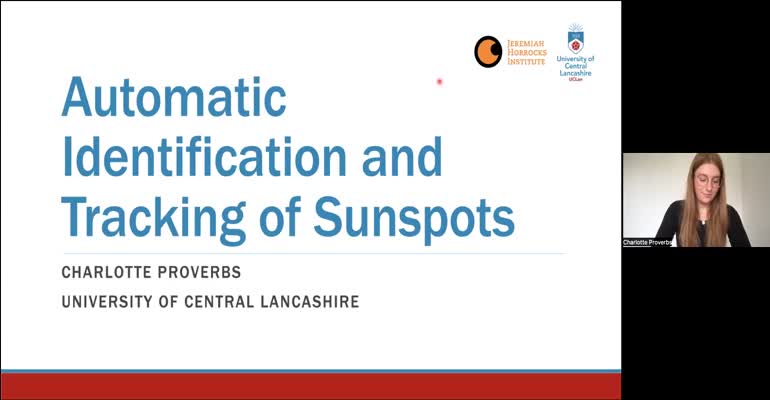
Automatic Identification and Tracking of Sunspots | Charlotte Proverbs
Natural Sciences (Astrophysics and Astrononmy)
1402 views
Date of upload:
14.06.2024
Co-author:
Caption:
It is well understood that the dynamics of sunspots lead to energy being transferred to the solar atmosphere and stored in the coronal magnetic field. This provides a surplus of energy that may be released in solar eruptions. The driving mechanisms for this energy transfer may include sunspot rotations, both within individual sunspots and between sunspot pairs. Calculation of the rotations of individual sunspots have been carried out by several authors, but studies of the rotation of sunspot pairs has been less systematically investigated. Read more at https://espos.stream/2024/06/13/Proverbs/.
img
First joint NuSTAR and Solar Orbiter/STIX X-ray observations of solar microflares | Natalia Bajnokova
Natural Sciences (Astrophysics and Astrononmy)
86 views
Date of upload:
28.11.2024
Co-author:
Caption:
Small solar flares, or microflares (GOES B class and fainter), are frequent bursts of energy released in the Sun’s atmosphere, exhibiting heating and particle acceleration similar to that of large flares. X-ray observations provide direct diagnostics to study these processes by examining thermal emission from the hot flare loops and non-thermal emission from accelerated electrons. We present analysis of the X-ray emission from small solar flares jointly observed with the Nuclear Spectroscopic Telescope Array (NuSTAR) and the Spectrometer Telescope for Imaging X-rays (STIX) on Solar Orbiter, providing different viewing angles of each event. NuSTAR is a highly sensitive X-ray imaging spectrometer that can directly image the Sun from 2.5 keV using focusing optics. Read more at https://espos.s
img
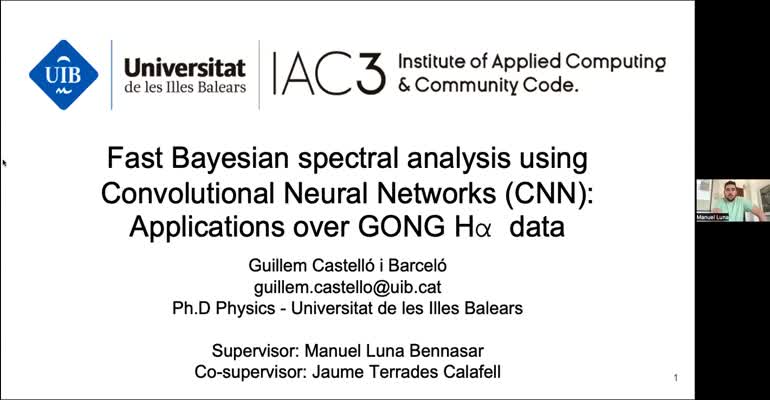
Spectral analysis of solar filaments using Convolutional-Neural Networks (CNNs) | Guillem Castelló i Barceló
Natural Sciences (Astrophysics and Astrononmy)
1259 views
Date of upload:
17.10.2024
Co-author:
Manuel Luna, Jaume Terradas
Caption:
Solar filaments (also called prominences when seen off-disk) are solar atmospheric structures consisting of dense, cool plasma clouds floating within the sun’s corona. Since the beginning of solar observations, it has been seen that the prominences oscillate with a wide variety of motions. These periodic motions are very common, but there are no systematic studies of these oscillations. It has recently been shown that spectral analysis of solar filaments is a powerful tool to identify oscillations in these structures. With this technique, the power spectral density (PSD) is calculated for each pixel of the Halpha images. To differentiate between a detection or a spurious oscillation, it is necessary to determine the background noise. Read more at https://espos.stream/2024/10/17/Castello/.

There are no uploaded posters yet.

There are no uploaded papers yet.

There are no uploaded presentations yet.

There are no uploaded conferences yet.